
You’ve been thinking about it for a while now; your smile isn’t quite where you want it, and you’re wondering whether Invisalign might finally be the right move. The question almost everyone asks before starting is a reasonable one: How long is this actually going to take? The honest answer depends on your case, but there’s a clear pattern in how treatment unfolds, and knowing what to expect week by week can make the whole process feel much more manageable.
At Smile Solutions, Dr. Amy Scepaniak and Dr. Aleaha Fettig Ledeboer are members of the American Academy of Clear Aligners, which means Invisalign isn’t just a service we offer; it’s something we’ve invested in understanding deeply. Whether your teeth have minor spacing or a more involved bite concern, we’re here to walk you through a timeline that’s realistic, not just optimistic.
The First Few Weeks: Getting Used to a New Normal
The first aligner tray feels different for almost everyone. You’ll feel pressure when you put it in, and some people notice mild soreness on the first day or two as their teeth begin to move. This is actually a sign the aligners are doing their job.
During these opening weeks, the biggest adjustment isn’t physical. It’s behavioral. Invisalign requires wearing your aligners 20 to 22 hours per day. That means they come out only to eat, drink anything other than water, and brush. For many patients, developing this habit takes the first couple of weeks to lock in. Because the trays are removable, keeping up with your dental cleanings and checkups is straightforward, and no brackets or wires get in the way.
What You Won’t See Yet
Visible change during week one is rare. Your teeth are shifting at a microscopic level, but the movement isn’t noticeable in the mirror yet. Some patients feel slight differences in how their bite feels, but this early stage is about laying the foundation, not celebrating milestones.
Months One Through Three: When Changes Start to Show
Most patients notice early improvements within the first two months of treatment. By the end of month one, small spaces may begin closing, or a rotation that’s been bothering you for years starts to correct. It’s a subtle shift, more likely noticeable in photographs than in the mirror on a rushed morning.
By month two, you’re likely settling into the rhythm of switching trays every one to two weeks. The aligners that felt snug on day one now feel almost loose by switch day, which is the visual proof that things are working. Friends who see you often may not notice yet, but you might start to.
Months Six Through Twelve: The Most Visible Progress
This is the phase patients tend to talk about. By mid-treatment, the changes in your smile are visible to people who haven’t seen you in a while. Gaps are noticeably smaller, crowding has relaxed, and the overall alignment of your teeth looks markedly different from where you started.
This is also the stage where compliance pays off in a clear, measurable way. Patients who consistently hit the 20-to-22-hour daily wear requirement tend to track closely to their projected timeline. Those who’ve been removing trays more often, even by just an hour or two a day, may find their progress lagging or their trays not fitting as precisely by switch day.
We may take updated photos or scans during this window to compare against your original records. If refinements are needed, additional aligner trays to fine-tune specific teeth, this stage is often when that’s identified and planned for.
What “Complete” Actually Means
Most people assume treatment is finished the moment their last tray is in. In reality, completing your aligner trays is one step in a two-part finish. The second step is retention: the phase that protects everything you just worked for.
When active treatment ends, your teeth are newly positioned but not yet stable. The bones and ligaments surrounding them need time to adapt to those positions. Without a retainer, teeth have a natural tendency to drift back toward where they started. Wearing your retainer as directed is what makes your results permanent.
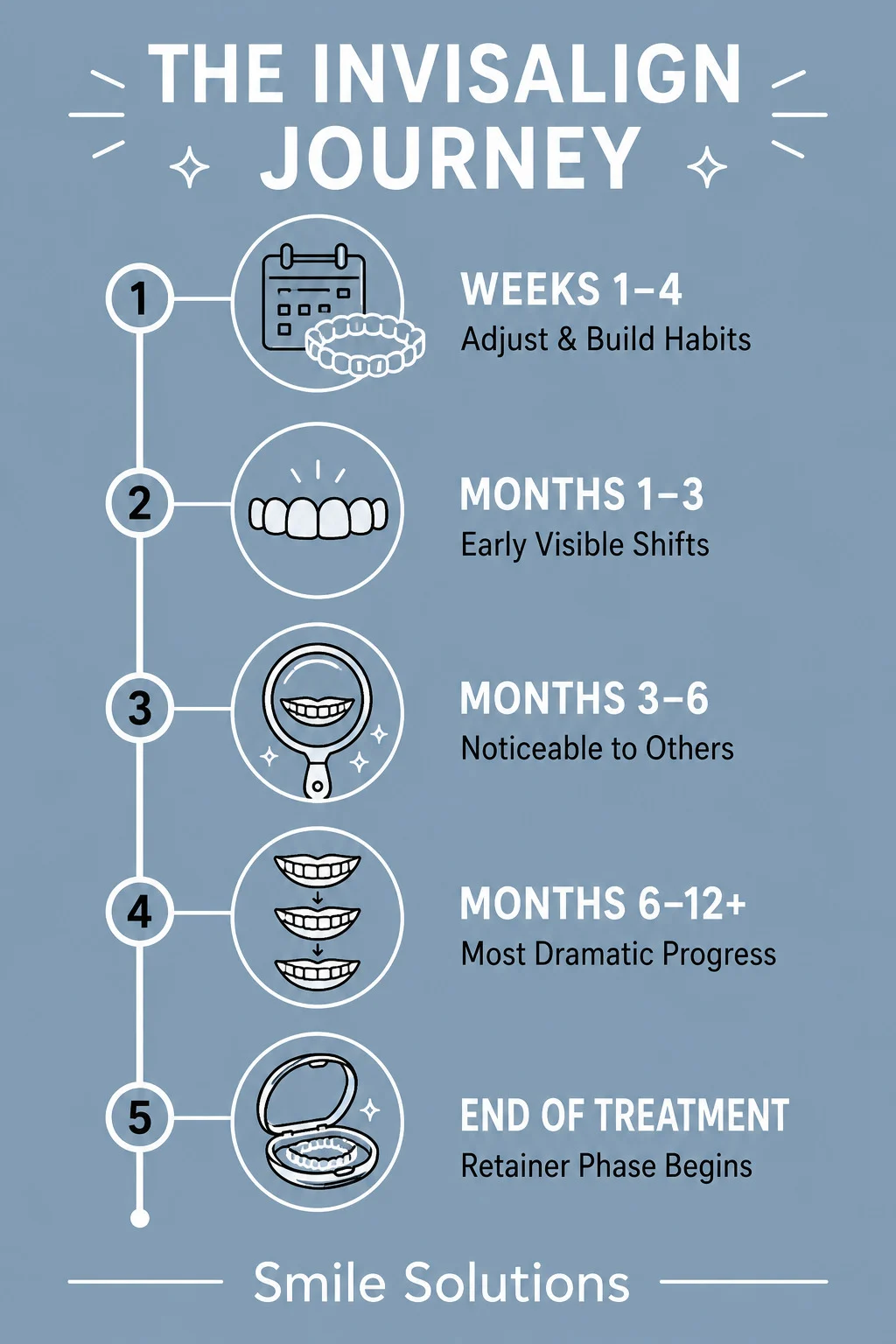
Here’s a quick look at how the full Invisalign journey breaks down:
- Weeks 1 to 4: Initial adjustment, mild soreness common, compliance habits form
- Months 1 to 3: Early visible changes begin, bite feels different, first check-in with provider
- Months 3 to 6: Friends and family start to notice, and mid-treatment tracking is confirmed
- Months 6 to 12+: Most dramatic visible progress, refinements added if needed
- End of treatment: Retainer phase begins to preserve your results long-term
The total time varies. Studies show that the average treatment time runs approximately 18 months for a range of case types, compared to roughly 24 months with conventional braces. Simpler cases with mild crowding or minor spacing can finish in as few as 6 to 12 months. More involved corrections may take longer.
Start Your Invisalign Journey at Smile Solutions
If you’ve been waiting for a reason to finally make the call, this is it. Smile Solutions has been serving Aberdeen and the surrounding communities in northeastern South Dakota since 2009, and our doctors bring both the credentials and the genuine care that make a real difference in your treatment. We accept Delta Dental and offer CareCredit and Cherry financing to make starting accessible, whatever your situation looks like.
When you’re ready to find out what your specific timeline would look like, we’d love to hear from you. Reach out through our contact form, and let’s start that conversation.